



The biggest venture checks of 2026 are no longer going to apps and software. They are going to companies bringing artificial intelligence into the physical world. A pair of enormous funding rounds shows just how aggressively investors are betting on “physical AI.”
Bezos’s $12 billion bet
The headline round came from a startup founded by one of the world’s richest people. The scale is extraordinary.
Jeff Bezos’s AI startup Prometheus announced a massive $12 billion Series B at a $41 billion valuation to scale its industrial AI software, with a platform that aims to act as an “artificial general engineer” optimizing design, production, and operations across industries.
A $12 billion Series B is almost unheard of, dwarfing most funding rounds entirely. It signals deep conviction that AI applied to engineering and manufacturing could be transformative.
Robotics draws giants
The second mega-round went to a robotics company, backed by a who’s-who of tech and crypto investors. The lineup is telling.
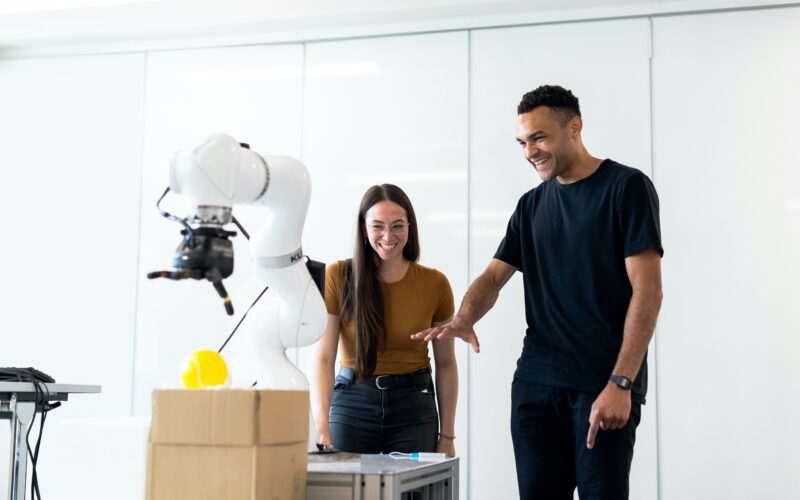
NEURA Robotics, a German physical AI robotics platform, revealed up to $1.4 billion in Series C funding led by crypto-native investor Tether alongside tech giants Qualcomm, Amazon, and NVIDIA. The participation of major chipmakers and cloud providers reflects how strategic robotics has become.
Together, these deals capture the dominant theme. These mega-rounds underscore a broader pattern: investors are betting on marrying AI with real-world systems like robots, factories, and hardware, not just digital apps. Mean CEO’s BLOG
Why physical AI is winning
The shift reflects a change in investor psychology. Pure software is no longer enough to command the biggest rounds.
Investor focus has sharpened on real-world AI and infrastructure, with venture capital answering calls to “onshore” critical technology and buyers signaling they want AI muscle for the physical world: industrial robots, satellites, and autonomous vehicles, not just cloud services. The thinking is that the AI software race is crowded and expensive, so the next opportunity lies in applying that intelligence to tangible systems.
Fintech and crypto join in
The mega-rounds were not limited to robots and factories. Financial infrastructure also drew big checks.
Digital Asset, a blockchain and fintech infrastructure company, raised $355 million from more than 70 investors including Andreessen Horowitz, bringing its total to roughly $500 million. Toronto-based fintech KOHO raised about $100 million in a Series E backed by Abu Dhabi’s Mubadala and Shopify’s CEO, becoming Canada’s latest unicorn. Mean CEO’s BLOG
What it means for founders
The message for entrepreneurs is increasingly clear. The market rewards companies solving hard, tangible problems.
Founders need to hit on big, tangible problems, and ideally tie into AI or high-value infrastructure, to command a top-tier round today, with investors prioritizing scale in enterprise software, advanced manufacturing, robotics, energy, and biotech. The era of raising enormous sums on a pure software pitch is fading. In its place is a market hungry for AI that can build, move, and manufacture in the real world. ScienceDaily
This article is for informational purposes and does not constitute investment advice.