


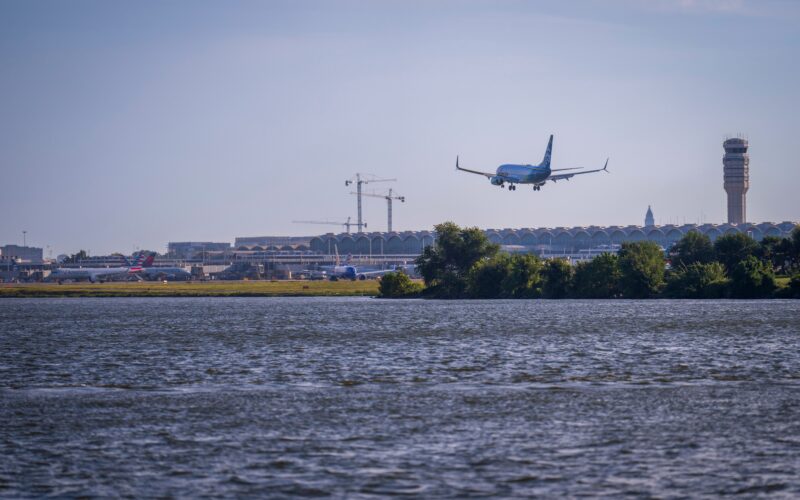
A DC airspace near miss has reignited a safety crisis that has haunted Washington’s aviation system all year. Specifically, a plane took off from Reagan National Airport during a Marine One flight on August 6, creating a dangerous situation in already congested airspace. Furthermore, the incident comes just months after January 2026’s devastating midair collision over the Potomac River that killed dozens. Here is what happened and why the DC airspace problem refuses to go away.
The DC Airspace Near Miss: What Happened Today
The incident occurred during a presidential helicopter operation. Specifically, the timing of the departure created a direct conflict. PBS NewsHour reported that a plane taking off during a Marine One flight has renewed serious concerns about Washington DC’s busy and chronically congested airspace, with aviation authorities investigating the circumstances of the near miss.
Furthermore, Reagan National Airport’s geographic position makes it uniquely dangerous. Specifically, the airport sits directly on flight paths used by presidential, military, and emergency aircraft operating from the DC area. As a result, the airspace around Washington requires extraordinarily precise coordination that today’s incident suggests was not achieved.
The January 2026 Collision Backdrop
Today’s near miss cannot be separated from the catastrophic collision earlier this year. Specifically, that disaster transformed DC airspace safety from a niche aviation concern into a national political issue. The January 2026 midair collision over the Potomac River between a commercial aircraft and a military helicopter resulted in dozens of fatalities and triggered the most significant review of DC airspace management since the airport’s expansion.
Furthermore, the FAA and Congress launched parallel investigations following the collision. Specifically, multiple corrective measures were announced, including new coordination protocols between military and civilian air traffic control. Consequently, today’s near miss raises the question of whether those measures have been fully implemented.
Why DC Airspace Is So Complex
Washington’s airspace is among the most complicated in the world. Specifically, it must simultaneously accommodate commercial aviation, presidential and VIP helicopter operations, military flights, and strict security restrictions. Furthermore, Reagan National’s short runways and proximity to restricted airspace leave almost no margin for error.
Aviation experts have long argued that the volume of operations at Reagan National exceeds what can be safely managed given these constraints. Specifically, flight paths cross in ways that require constant, precise coordination between multiple control authorities. As a result, any breakdown in communication or procedure can rapidly create dangerous situations.
The Broader Aviation Safety Picture
Today’s DC airspace near miss is not an isolated concern. Specifically, aviation safety has been under intense scrutiny throughout 2026. Furthermore, the JFK drone collision reported last month and multiple flight delay events at major hub airports this summer all point to an air traffic management system under significant strain.
The FAA is currently managing staff shortages, aging technology infrastructure, and record passenger volumes simultaneously. Consequently, the pressure on controllers and systems is higher than at any point in recent decades. For travelers, the summer of 2026 has repeatedly demonstrated that aviation safety is not a problem that was solved — it is a challenge that requires constant vigilance.
This article covers an active investigation. Details may change as the FAA and aviation authorities release further information.
You may be interested in this article: Drone Collision at JFK: JetBlue Pilot Confirms Incident as Airspace Fears Grow.